Quick Answer: Japan doesn’t hand out “free” work visas, but two real, low-cost pathways exist in 2026: the MEXT Scholarship (fully funded — tuition, monthly stipend, and airfare covered for students) and the Specified Skilled Worker (SSW) visa (no university degree required for foreign workers). Below is the exact process for both.
Why Japan Is Actively Recruiting Foreign Talent in 2026
Japan is expanding international admissions toward a national goal of 400,000 international students by 2033, while also widening its labor-shortage visa program to 19 industries. This is why both scholarship and visa routes have gotten more accessible this year — not because anything is “free,” but because eligibility requirements have loosened for the right candidates.
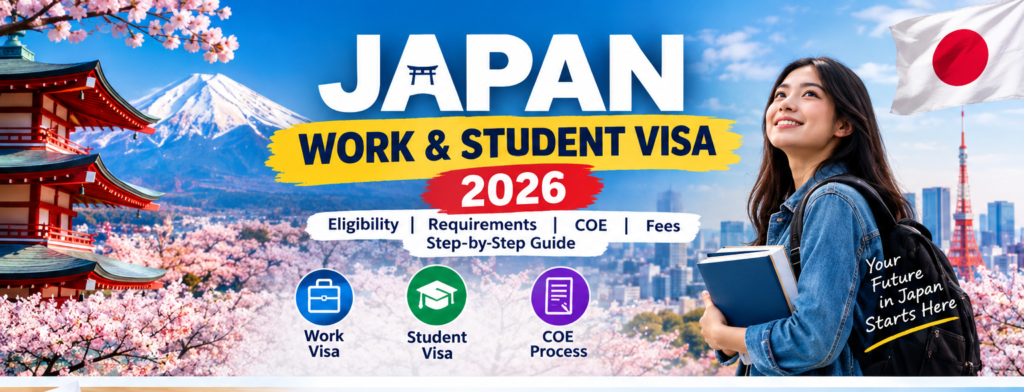
Part 1: MEXT Scholarship (Fully Funded Study in Japan)
The Japanese Government’s MEXT (Monbukagakusho) Scholarship is the most reliable free-study route to Japan. It covers:
- Full tuition and entrance exam fees at the university
- A monthly stipend (varies by program level and region)
- Round-trip economy airfare from your home country to Japan
- A one-year Japanese language preparatory course for undergraduates
It does not cover visa fees or costs for accompanying family members — worth mentioning upfront so readers don’t feel misled later (this also keeps your content Google-Ad-Manager-safe).
Step-by-Step MEXT Application Process
- Check eligibility – You must hold a passport from a country with diplomatic ties to Japan, and not already be enrolled as a privately-financed student in a Japanese institution.
- Choose your track – Embassy Recommendation (apply through your local Japanese embassy) or University Recommendation (apply directly if a Japanese university nominates you).
- Watch the timeline – Applications typically open in April–May each year through the embassy route, for enrollment the following year. Always download the current year’s official application booklet — old forms get rejected at screening.
- Prepare documents – Academic transcripts, recommendation letters, a research plan or statement of purpose, medical certificate, and passport copy (translated into English or Japanese where needed).
- Sit the embassy exam – Shortlisted applicants take a written exam and interview at the embassy.
- Get nominated to MEXT – The embassy forwards top candidates to the Ministry for final selection.
- Receive your Certificate of Eligibility (CoE) and apply for your student visa once confirmed.
Category options: Research Students (Master’s/PhD — most common), Undergraduate, Specialized Training College, and Japanese Studies (1-year non-degree track).
Part 2: Specified Skilled Worker (SSW) Visa — Work in Japan Without a Degree
This is the realistic “work visa without heavy requirements” pathway people are searching for. Unlike Japan’s standard Engineer/Specialist visas, SSW does not require a university degree or years of formal experience.
Who Qualifies
- Pass an industry skills test in one of 19 designated sectors (nursing care, construction, hospitality, manufacturing, agriculture, and more)
- Pass a Japanese language test — usually JLPT N4 or the JFT-Basic
- Secure a job offer from a registered Japanese employer
SSW Type 1 vs Type 2
| Factor | SSW Type 1 | SSW Type 2 |
|---|---|---|
| Max stay | Up to 5 years, non-renewable | Renewable indefinitely |
| Family allowed | No | Yes |
| Path to permanent residency | Doesn’t count | Can count toward PR |
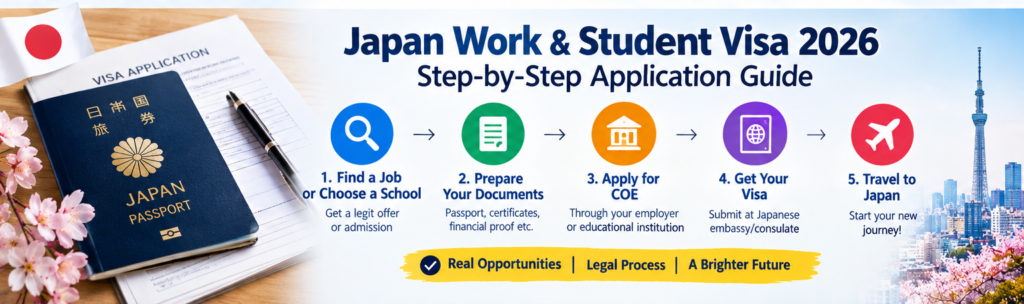
Step-by-Step SSW Application Process
- Pick your industry and check the relevant skills test schedule (varies by country and sector).
- Pass the skills exam and the Japanese language test.
- Secure a job offer from an employer registered to sponsor SSW visas.
- Employer applies for your Certificate of Eligibility (CoE) with Japan’s Immigration Services Agency — this step currently takes roughly 1–3 months.
- Employer sends you the CoE (valid for only 3 months, so move fast).
- Apply for the visa at your nearest Japanese consulate/embassy with your CoE, passport, photos, and signed employment contract.
- Travel and start work under your employer’s mandatory support plan (they’re legally required to help with housing, orientation, and language support).
⚠️ Heads-up for 2026: Japan’s immigration agency has proposed new permanent residency rules (income thresholds, Japanese language proficiency, public conduct checks) expected from October 2026 onward — worth checking before making long-term plans.
Common Mistakes to Avoid
- Confusing “SSW visa” with a free entry scheme — you still need to pass exams and find a sponsoring employer
- Using outdated MEXT application forms from a previous year
- Assuming family members are automatically covered — under MEXT and SSW Type 1, they generally are not
- Missing the CoE’s 3-month validity window
FAQ
Is the MEXT scholarship really free?
Yes — tuition, stipend, and airfare are covered. Visa fees and dependents’ costs are not.
Do I need a degree for the SSW work visa?
No. SSW is specifically designed for workers without a university degree, unlike Japan’s Engineer/Specialist visas.
Can I bring my family on these visas?
Not under MEXT (student) or SSW Type 1. SSW Type 2 permits family accompaniment.
How long does the work visa process take?
Roughly 3–5 months from skills test to arrival, mainly due to the CoE processing time.